



09
2023.09
Wildfires Without End: In a World of Extreme Heatwaves, Where Does the Road to Decarbonization Go?





According to Lianhe Zaobao, earlier last month, Singapore’s Acting Minister for Transport Chee Hong Tat announced during the Committee of Supply debate on the ministry's expenditure budget in Parliament that, from 2030, new harbour craft operating in the Port of Singapore must be fully electric or powered by net-zero-emission fuels. The Maritime and Port Authority of Singapore (MPA) has also called on the industry to begin discussions as early as possible on the feasibility of vessel electrification and the use of zero-emission fuels such as B100 biodiesel or hydrogen, and to proactively consult with the MPA. It is understood that, from 2027, this consultation process will become mandatory.
To support its goal of achieving net-zero emissions by 2050, and to fulfill commitments under the UN 2030 Agenda for Sustainable Development, the Paris Agreement, and the International Maritime Organization (IMO) Initial Strategy to reduce greenhouse gas (GHG) emissions from ships, Singapore has in recent years continued to explore the application of green low-carbon and zero-carbon fuels in the maritime sector.
- Biofuel Trials -
In mid-last month (on the 15th), with close coordination and support from the relevant authorities, China Merchants Energy Shipping’s vessel “Kaide” successfully completed the bunkering of 500 tonnes of biofuel at an anchorage in Singapore, and has been operating stably since the trial began on 26 March. This trial was jointly carried out by the time charterer China National Petroleum Corporation International (Singapore) Pte. Ltd. and Haihong Shipping (Hong Kong) Co., Ltd., a subsidiary of China Merchants Energy Shipping. As a major supplier in the local marine bunkering market, CNPC International has taken an early lead in developing the bio-bunker business, having initiated and completed the relevant preparatory work last year.
In fact, since 2021, the Maritime and Port Authority of Singapore (MPA) has been encouraging marine fuel suppliers and buyers to explore and transition toward greener, low-carbon fuels.
To support trials conducted by shipping companies assessing the carbon-reduction potential of biofuels, the MPA has established a framework that allows licensed bunker suppliers—subject to compliance with the framework conditions—to supply biofuels to vessels within the Port of Singapore.
As a fuel supplier, the supply of biofuels within the Port of Singapore must meet the following conditions:
The fuel supplier shall ensure that the mass flow meter (MFM) installed on the bunker vessel is suitable for measuring biofuels, is supported by the MFM supplier, and has a measurement uncertainty of no more than 0.5%.
The biofuel supplied shall meet the density and kinematic viscosity specifications as set out in the MFM approval letter issued by the MPA for the bunker vessel.
The fuel supplier shall ensure that the bunker vessel’s Flag State Administration and Classification Society have approved, or have no objection to, the loading, carriage, and delivery of biofuels on board the bunker barge.
The fuel supplier shall also ensure that the delivery of biofuels is notified to the MPA’s Standards & Investigation – Marine Fuels (SIMF) Department. All monthly bunker sales returns submitted to the MPA shall include biofuel deliveries (classified under the usual fuel type and grade for conventional fuels, e.g., LSFO180, MFO380, MGO).
The supply of biofuels as fuel shall be fully incorporated into the commercial agreement between the fuel supplier and the fuel buyer.
The fuel supplier shall confirm that the receiving vessel’s master/owner has obtained the necessary waivers from the relevant Flag State Administration to conduct emissions reduction trials, prior to delivery.
Blending on board bunker vessels within the Port of Singapore is not permitted.
The Certificate of Quality (COQ) shall be issued only by the loading facility and must be provided prior to the delivery of biofuels in Singapore. The specification shall comply with ISO 8217:2017 (except Clause 5.1 on FAME levels under ISO 8217:2017).
All loading operations shall be carried out in accordance with all applicable statutory requirements and port/coastal State requirements.
Biofuel blends shall also be subject to FAME testing, and the results shall be included in the COQ.
The COQ shall be submitted to the SIMF Department at least one day before the delivery of biofuels. Any other information relating to the biofuel shall be provided to the MPA upon request.
The product name of the biofuel supplied shall be duly stated in the Bunker Delivery Note (BDN).
The fuel supplier shall retain records of all relevant documents.
In addition, to support the decarbonisation of the maritime industry, the MPA ha identified seven key focus areas under its long-term maritime decarbonisation strategy, the “Towards 2050” Maritime Decarbonisation Blueprint, aimed at strengthening Singapore’s value as a leading global hub port and an international maritime centre. Biofuel bunkering is listed as one of these key focus areas.
- Maritime Green Initiatives-
In the areas of port terminals and harbour craft, the MPA has also introduced the Maritime Singapore Green Initiative (MSGI), which aims to reduce the environmental impact of shipping and related activities and to promote cleaner and greener shipping. Currently, the Green Ship Programme (GSP) and the Green Port Programme (GPP) under the MSGI are in operation. In 2019, the initiative was further extended to 31 December 2024.
Green Ship Programme (GSP)
1 May 2022 – 31 December 2024
The Green Ship Programme (GSP) is one of the four schemes under the Maritime Singapore Green Initiative (MSGI). A core principle of this broad-based scheme is to reward shipowners who voluntarily adopt solutions enabling their vessels to exceed the environmental regulatory standards set by the IMO.
Under the GSP, the MPA provides incentives for Singapore-flagged vessels that meet one or more of the following criteria:
Exceed the IMO’s MARPOL Annex VI Phase 3 EEDI requirements by 10% or more;
Install engines capable of using low-carbon fuels, with a CF (conversion factor between fuel consumption and CO₂ emissions) that is equivalent to or lower than that of LNG, such as (bio)-LNG, (bio)-methanol, or (bio)-ethanol;
Install engines capable of using zero-carbon fuels (e.g., ammonia or hydrogen).
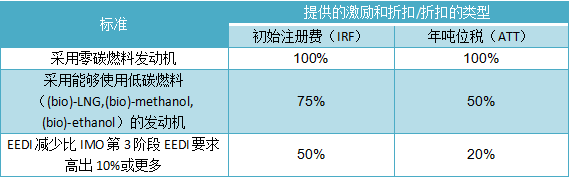
P.S. For vessels that meet multiple criteria, a higher discount rate will apply.
Based on Circular No. 07 of 2022, the details are as follows:
For Singapore-flagged vessels that exceed the IMO MARPOL Annex VI Phase 3 EEDI requirements by 10% or more, a 50% discount on the Initial Registration Fee (IRF) will apply under both the normal registration and the Block Transfer Scheme (BTS). These vessels will also enjoy an annual rebate of 20% on the Annual Tonnage Tax (ATT) payable.
In addition, vessels registered with the Singapore Registry of Ships (SRS) that exceed the Phase 3 EEDI requirements by 10% or more may also participate in this programme, but will only receive the 20% ATT rebate.
Singapore-flagged vessels that use LNG, or use as their main fuel a fuel with a CF (conversion factor between fuel consumption and CO₂ emissions) lower than LNG, will enjoy a 75% IRF discount and a 50% ATT discount. Existing Singapore-registered vessels may also participate, but will only be eligible for an annual 50% ATT rebate.
The scheme also recognises Singapore-flagged vessels that use zero-carbon fuels (such as ammonia or hydrogen) as their main fuel. These vessels will receive a 100% IRF discount and a 100% ATT discount.
Notably, vessels that qualify under this scheme will receive a “Green Endorsement Letter” issued by the MPA, and the same Green Endorsement will also be granted to the company that owns the qualifying vessel(s).
Green Port Programme (GPP)
1 May 2022 – 31 December 2024
The Green Port Programme (GPP) is one of the schemes under the Maritime Singapore Green Initiative (MSGI). The programme encourages environmental sustainability among ocean-going vessels calling at the Port of Singapore and MPA-licensed harbour craft.
Taking into account the updated requirements under the IMO Energy Efficiency Design Index (EEDI) Phase 3, the applicable port dues concessions for vessels calling at the Port of Singapore and participating in the GPP are as follows:

According to Port Marine Circular No. 10 of 2022, the details are as follows:
A 30% reduction in port dues applies where zero-carbon fuels are used;
A 25% reduction in port dues applies where low-carbon fuels other than LNG are used;
A 25% reduction in port dues applies where a vessel’s EEDI reduction exceeds the IMO Phase 3 EEDI requirement by 10% or more.
In addition, MPA-licensed harbour craft approved for the use of low-carbon or zero-carbon fuels will be eligible for an additional 10% reduction in port dues, subject to the following conditions:
Applicable only to GPP-registered harbour craft engaged in port operations involving low-carbon or zero-carbon fuels;
The harbour craft operator using low-carbon or zero-carbon fuels must submit daily declarations to verify that they are servicing their respective GPP-registered vessels;
Operators of low-carbon or zero-carbon harbour craft providing services to GPP-registered vessels must register with the “Service Information Submission System” via the MPA’s digital platform @SGTM;
During each port stay, the maximum port dues concession is capped at 10%, regardless of the number or frequency of low-carbon or zero-carbon harbour craft used by the GPP-registered vessel.
※ The above content is compiled and edited by Johnny Cui Law Firm.
Reproduction or redistribution is permitted only with proper source attribution.
Wildfires Without End: In a World of Extreme Heatwaves, Where Does the Road to Decarbonization Go?
Malaysia’s New Energy Vehicle (NEV) Development Status and BEV Application Requirements

Singapore's Key Policies on Carbon Emissions Reduction
Southeast Asia emerging market e-commerce growth observation